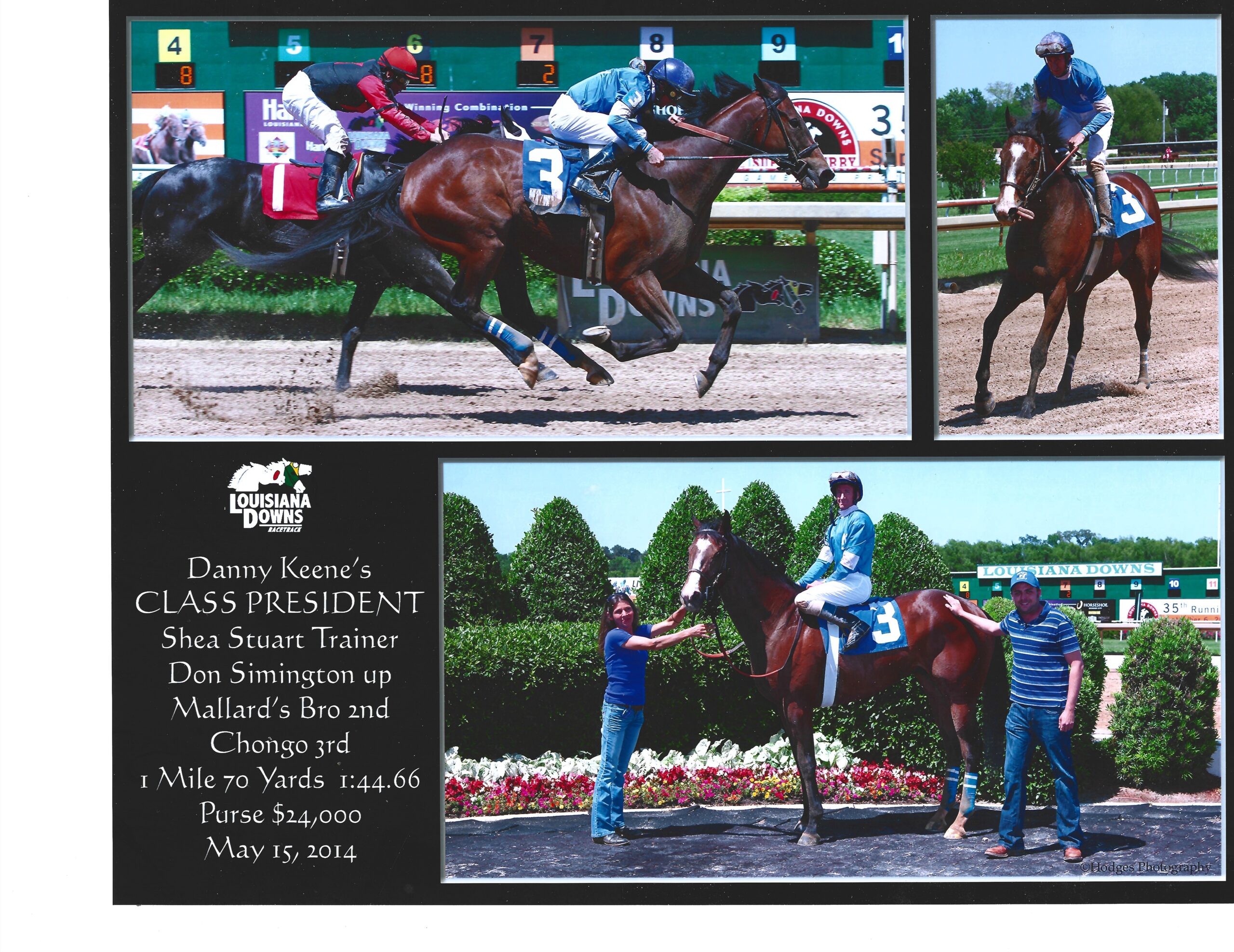

Every trainer knows the anticipation—and the knot in the pit of your stomach—that comes with waiting for the stall application list to come out.
When you’re an independent trainer working day in and day out to build a business, that piece of paper doesn’t just dictate where your horses sleep for five months. It dictates your livelihood. It sets the ceiling on your income, tests your loyalty to your owners, and shapes the trajectory of your entire stable.
Racing at Oaklawn Park is special. Hot Springs is where I want to be, it’s where my clients want to run, and it’s where we’ve proven we can win. This upcoming meet marks my 12th consecutive year stabled and racing at Oaklawn. Over more than a decade on this backstretch, I hav
e paid my dues through every high and low this game can throw at you. I’ve supported the entry box, respected the track, and responded with honest, hard-running horses that show up every race day. I’m not asking to take over half a barn overnight—I simply want the opportunity to slowly, legitimately grow my business.
Yet year after year, I find myself fighting an uphill battle before a single horse even steps foot onto the track.
Every single season, I get fewer stalls than I ask for. And let me make one thing clear: I don’t play the padding game. I don’t ask for 25 stalls hoping to get 15. I only ask for what I have ready, qualified, and legitimate owners paying day rates to run. I ask for what I need.
Making Miracles Out of Shortfalls
Last meet was a prime example. I put in for 15 stalls. The racing office gave me 9.
Cutting almost half of your planned roster forces you into an immediate triage. You have to make heartbreaking phone calls to loyal owners telling them their horses can’t come. Somehow, my team and I put our heads down, hustled, and made it work.
The numbers from that 9-stall foot
print speak for themselves:
-
Starts: 55
-
Record: 7 wins, 8 seconds, 5 thirds (20 top-three finishes)
-
Win Rate: 13%
-
Total Earnings: $574,114
-
Average per Start: $10,438.44 ($574,114 across 55 starts)
-
Meet Standings: Finish
-
ed #23 overall among all trainers on the grounds
Averaging over $10,400 every single time we led a horse over from a 9-stall barn proves our efficiency. We hit the board 36% of the time, and our horses earned real money for their connections. But beneath that success was a painful truth: I left substantial income on the table. Every empty spot that should have been filled by a horse in my care was revenue lost, momentum halted, and potential winners left behind.
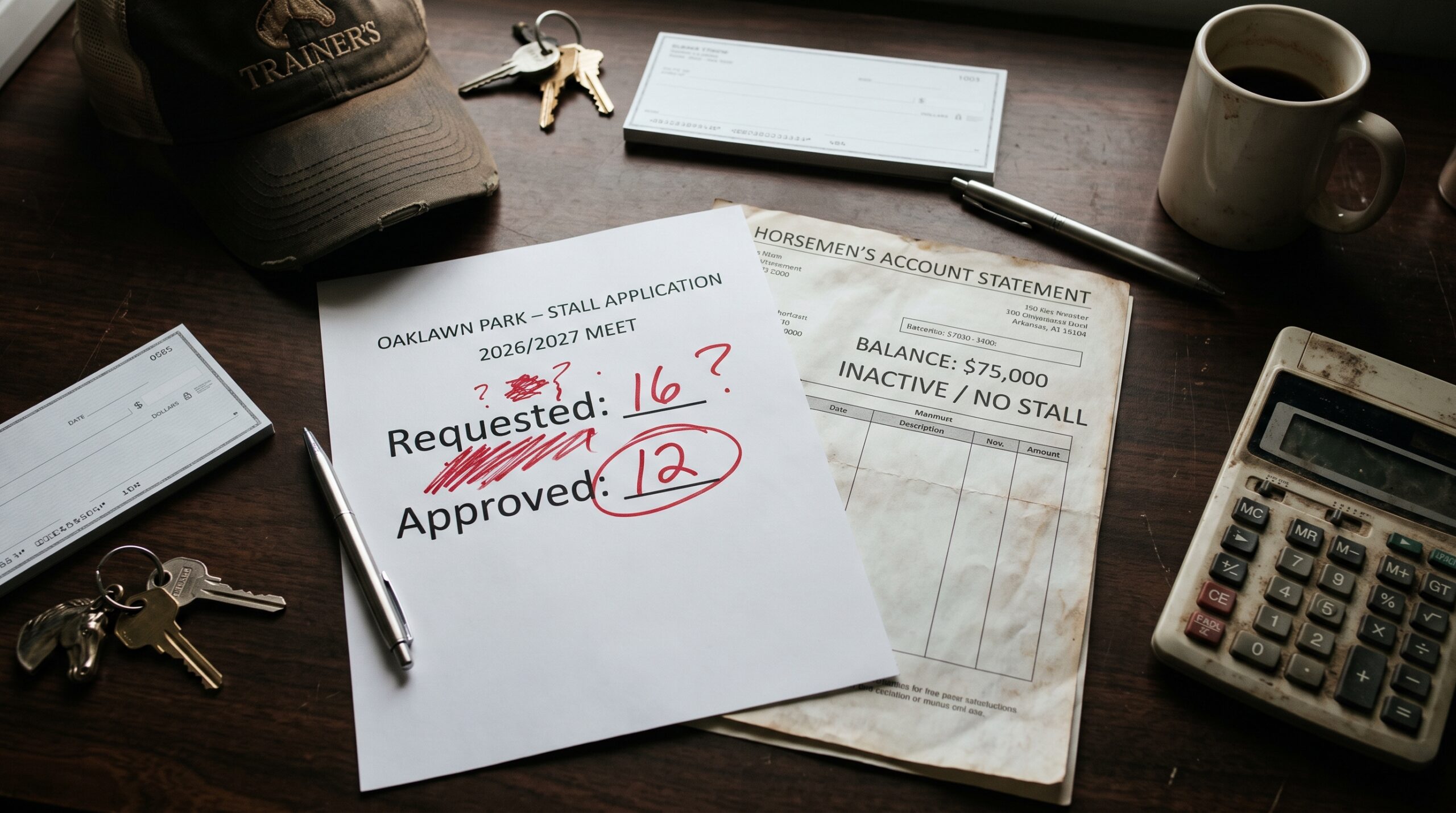
Going into this year, we pushed hard to expand our footprint. I asked for 16 stalls. When the allocations came back, we were awarded 12.
Look, I’ll be fair—12 is better than 9. I appreciate the improvement, and I don’t take any stall at Oaklawn for granted. But four stalls short of a full string still puts our operation in a terrible bind, especially when you look at how those 12 stalls were divided up:
-
8 stalls were designated for specific horses.
-
4 stalls were left to my discretion.
That’s where the real headache begins.
The Problem With Loving Arkansas-Breds
When you break down the roster, you start to see a frustrating pattern emerge.
Right now, I have four Arkansas-bred two-year-olds—two fillies and two colts—with talent, heart, and bright futures ahead of them. Not a single one of them was assigned a stall by the racing office.
On top of that, Al’s Romeo didn’t get a stall.
If you know my barn, you know Al’s Romeo. He’s one of the absolute best horses I have ever had the privilege to put a bridle on. He is a multiple-time winner right here over the Oaklawn surface, a horse that has earned his feed and then some, running his eyes out in front of the l
ocal crowd. To see his name left off the assigned list feels like a slap in the face not just to me, but to a proven racehorse who has laid it on the line at this track time and again.
So now, I’m left staring at four discretionary stalls and a barn full of horses that deserve to be there. Do I bring the two-year-olds who need the seasoning and have their entire careers ahead of them? Or do I bring proven warriors like Al’s Romeo? No matter which way I cut it, somebody gets left behind.
The honest truth? Sometimes it feels like you get penalized for building your program around Arkansas-breds.
Yet, Arkansas-breds are the lifeblood of what I do. They are what I excel with. They are what I’ve built my reputation on. Most importantly, they are the horses that fit my clients’ budgets. M
y owners aren’t buying six-figure yearling prospects out of Keeneland September; they are hard-working folks who invest their hard-earned money into local bloodstock, believing in the state program and dreaming of winning on their home track.
The Cold, Hard Data on Arkansas-Breds
This isn’t just a gut feeling or em
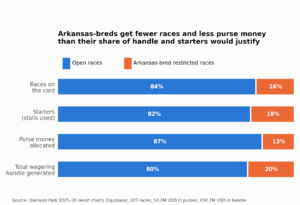
otional venting; the numbers back it up completely. When you examine the actual data from the 2025–26 Oaklawn meet across 627 races, $54.2M in purses, and $430.7M in wagering handle, the disparity is stark:
-
Total Wagering Handle Generated: Arkansas-bred restricted races drive 20% of the entire meet handle. Bettors love them, full fields pack the gates, and the betting public wagers heavily on them.
-
Starters (Stalls Used): State-breds account for 18% of the total starters utilizing backstretch stalls.
-
Races on the Card: Despite generating a fifth of the handle, only 16% of races are actually carded and written for Arkansas-breds.
-
Purse Money Allocated: Only 13% of total purse distribution goes to Arkansas-bred restricted races.
Arkansas-breds literally punch above their weight on the wagering board, yet they receive fewer races and a smaller share of the purse pie than their starter volume and handle contribution justify. When you see those numbers laid out, it becomes impossible not to question why local barns loaded with state-breds get shut out of the very stalls required to enter them.
The Claiming Dilemma: Capital Ready, Nowhere to Put Them
The stall shortage doesn’t just handcuff the horses currently in my barn—it completely stalls our ability to recruit and expand.
Right now, my current owners are actively looking for horses to claim. On top of that, I have multiple other prospective clients with real money sitting in horsemen’s bookkeeper accounts, ready to drop claims and bring horses to Oaklawn under my name. The demand is there. The capital is there.
The stalls are not.
People on the outside might say, “Why not just keep some at an off-track training center or a secondary barn?”
Beyond the logistical nightmare of splitting your staff and hauling horses back and forth, having horses scattered across multiple facilities today isn’t just an annoyance—it’s a massive, legitimate liability. Under modern HISA regulations and today’s ultra-sensitive post-race testing, labs are detecting foreign substances down to the single-digit picogram level. That is parts-per-trillion sensitivity.
When your horses are under your direct roof, you control the feed, the hay, the water buckets, the supplements, the bedding, and every hand that touches them. The second you have to farm horses out to secondary barns or off-track facilities to accommodate stall caps, you lose complete chain-of-custody control. One contaminated stall, an unwashed bucket, or casual cross-contamination from outside personnel can trigger a positive test that derails your entire career and reputation. In the HISA era, tight, centralized barn control isn’t a luxury—it’s survival.
A Lesson from Virginia: Rewarding the Home Team
The frustration with state programs becomes even clearer when you look at how other jurisdictions protect their own.
Recently, I’ve started sending horses to Virginia to participate in their residency and certification program. What they’ve built there makes complete business sense: if a horse is Virginia-bred or a Certified Virginia Thoroughbred (having spent the required minimum residency in the state), that horse is guaranteed a stall for the race meet at Colonial Downs. Full stop. They recognize that if you invest in their farms, their feed stores, and their local equine economy, the track owes you an opportunity to compete.
I don’t see why it should be any different right here in Arkansas.
Oaklawn offers some of the highest, most lucrative purses in all of North America. If anybody deserves priority access to that purse money and those stalls, it should be the people who live here, work here, and spend their money in this state 365 days a year.
Growing the Game at the Turnstiles and the Tables
Beyond breeding economics, there is a fundamental fan and patron reality the racing office overlooks: Arkansas-bred horses bring local people through the gates.
More Arkansas-breds are owned by local folks—people from Hot Springs, Little Rock, Fort Smith, and all across the state. When their horse is entered, they don’t just watch an online feed from a thousand miles away. They pack the grandstand. They bring their spouses, their kids, their neighbors, and their friends. They buy programs, hot dogs, beers, and souvenirs.
There is nothing in horse racing quite like getting to stand in the winner’s circle for the very first time. It is an unforgettable experience, and when a local owner gets that win, it is deeply rooted in local history, state pride, and genuine community. That emotional thrill is how you hook brand-new lifelong racing fans and future owners, growing this sport from the grassroots up.
And then there’s the casino floor.
When an out-of-state outfit ships in, runs, and collects a check, that money gets wired straight back to Kentucky, New York, or California. Those owners often never set foot in Hot Springs.
Contrast that with local owners and trainers. When local people earn purse money here, that capital stays here. After a winning afternoon, local owners aren’t wiring funds out of state—they’re walking into the Oaklawn casino, sitting down at the tables, playing the machines, dining at the track restaurants, and reinvesting that money right back into the facility. Supporting local horsemen directly feeds the track’s entire commercial ecosystem, from the apron to the turnstiles to the blackjack tables.
When local owners and trainers who support the Arkansas breeding industry year-round get squeezed out for out-of-state strings that pull up for the winter and vanish in May, it sends the wrong message to everyone investing in Arkansas racing.
Keeping the Game Alive Requires Cooperation
Trainers are walking away from horse racing every single day. The margins are razor-thin, labor is harder to find than ever, regulatory burdens are heavier, and overhead keeps climbing. Over the past few years alone, we’ve watched trainers who used to bring strings to Oaklawn—barns with far more stalls than I’ve ever been allocated—hang it up and exit the business entirely.
I love this sport. I love this track. I want to continue doing this for decades to come, but sustaining an independent racing stable requires cooperation from multiple fronts. It takes owners willing to fund the stock, a trainer and backstretch crew willing to pour in 14-hour days, and a racing office willing to give reliable, homegrown horsemen the physical footprint they need to survive and take the next step.
We’re going to show up this meet, just like we always do. We’re going to work with the 12 stalls we’ve got, we’re going to place our horses where they can win, and we’re going to make every single runner count.
To my owners: thank you for standing by me through the logistics and the headaches. To the fans and fellow horsemen: we’ll see you on the backstretch. We might not have the numbers of the mega-barns, but dollar for dollar, horse for horse, we’ll be ready to run.
– Shea